98 years – Ballestrins in Adelaide

The photo above tells a story about Ballestrin families who migrated to Australia from Vallà in the province of Treviso between the wars. The wedding of Luigina Ballestrin and Eugenio Zalunardo took place in Adelaide in 1943. Luigina was the youngest of ten children and with her mother, Santa Agata, she had migrated in 1939. They joined four other family members and a cousin who were already living in Adelaide. The Ballestrin family was establishing a network – a family tree in Adelaide. (The photo was provided by Norma Camozzato nee Ballestrin and Silvano Ballestrin identified the individuals.)

Arrival in Adelaide, 1927
It is 98 years since Antonio and Isidoro Ballestrin arrived in Adelaide with their 17-year-old-cousin, Giuseppe, on 21st September 1927, leaving a large family household at Vallà  in the Veneto region that could not provide adequate food or enough land  to divide between sons as the children in two Ballestrin families came of age and married.

Map with Valla’ identified. mapcarta.com

The food was not grown for income – it was for a household to exist. Frank Ballestrin, the son of Isidoro, estimated that there were 17 children living in that household at the time that the first of the Ballestrins migrated. You can understand the need for some young men to make that decision to migrate and have more opportunities for the future.

 Marriage in Adelaide, 1943
When you look at the photo, the first feature you notice is the formality of the portrait. It was war time with restrictions on buying clothing and other goods. Yet everyone is dressed to fit the occasion, and they gather around Luigina and Eugenio as a kind of protective, caring group. Luigina and her attendants hold beautiful flowers. She was marrying a man who, along with her brothers and their wives, was a member of the Veneto market gardener community at Lockleys.

Like many in the group of Veneto market gardeners, Eugenio had arrived in 1927. At the time of the marriage, he was leasing land on Grange Road next door to Antonio and Romilda Ballestrin. The marriage would have been acknowledged as ‘suitable’ because Eugenio was ‘known’ in the sense that he was from the same area in the Veneto region and he was making his living from growing vegetables – as they were doing in the Lockleys area.

Luigina Ballestrin and Eugenio Zalunardo c 1943.

Both Eugenio and Luigina chose members of their wedding party from other Veneto market gardener families. Eugenio had Romildo Santin as his best man and Luigina’s bridesmaid was Rosina Tonellato and her sister, Assunta, was one of the flower girls. The other flower girl in a matching dress, was Santina, daughter of Isidoro and Gina Ballestrin. Giuseppe, the cousin, who had arrived in 1927 with his two cousins is in the photo with his family, wife, Cesira and children, Lino and Norma, in her father’s arms at the back.

Children from three different Ballestrin families are in the photo. One other adult included in the extended family photo is Arturo Cecchetto, a brother-in-law of Antonio Ballestrin who lived in Adelaide for a few years. He stands next to Giuseppe Ballestrin and his small daughter, Norma.

 Luigina’s mother, Santa Agata is third from the right in the front. She died in 1945 aged 71 years.

Six Ballestrin families in Adelaide
In the wider Ballestrin family, six separate family groups settled in Adelaide before WWII and were market gardeners in the Kidman Park, Flinders Park area. Eight of the second generation from four of the families were interviewed for the oral history project.

Antonio Ballestrin leased land on Grange Road with his wife Romildo Minato. They had nine glasshouses and apart from tomatoes, grew a range of other vegetables.

Passport – Antonio Ballestrin. NAA:435, 1945/4/6540.

Isidoro and Gina had three children, Santina, Frankie and Dolfina. Frankie carried on in the market garden after his father died in 1965 and continued to grow vegetables commercially at Flinders Park and Bolivar until he retired.

Luigina Zalunardo nee Ballestrin with Noemi and Gina Ballestrin with Dolfina, Grange Road, c 1947. Photo provided by Noemi Campagnolo nee Zalunardo.
Isidoro and Gina, Frankie and Santina Ballestrin c1943. Dolfina was born later. Photo provided by Frankie Ballestrin.
Ermengildo Ballestsrin, preparing celery for market. C 1950s. Photo provided by Ric and Angelo Ballestrin.


Ermenegildo was 26 years when he migrated in 1937. He married Norina Berti and they had two sons, Ric and Angelo. They lived on Hartley Road and shared a partnership with cousin, Giuseppe.


Ballestrin family: Narciso, LIna, Maria, Jimmy. Front: Silvano, Norina. Flinders Park, c 1959.
Photo supplied by Lina Campagnaro nee Ballestrin.

Narciso emigrated in 1938, leaving behind his wife Maria Dotto and their infant son, Egidio. The family was reunited in 1940. Three other children were born in Adelaide, Lina, Silvano and Norina. Their market garden was off River Road, now Findon Road.

Zalunardo family: Eugenio, Luigia, Renato, Noemi, Grange Road, c1964. Photo provided by Noemi Campagnolo nee Zalunardo.


Luigina and Eugenio Zalunardo grew vegetables on Grange Road and had two children, Noemi and Renato. Luigina died after a long illness in 1965.


Giuseppe and Cesira Ballestrin, 50th wedding anniversary – Lino, Norma, Louis and spouses and grandchildren, , 1984.

Giuseppe and Cesira had three children, Lino, Norma and Louis and they worked 20 acres on Hartley Road in partnership with Ermenegildo and Norina who had two sons, Ric and Angelo.


The families adapted to life in Australia and became successful vegetable growers. Although they faced challenges in World War II, they all purchased land after the war when it was possible for ‘enemy aliens’ to sign contracts for sale.

Ballestrin families – tomato growers

Ballestrin truck after transferring tomatoes for sale in Melbourne, late 1950s. Newspaper, unidentified.

In the photo taken by a newspaper in 1950, Ballestrin relatives are near their truck after their cases of tomatoes had been loaded onto a semi-trailer. The Victorian train strike ran for 10 weeks from October to December 1950 and created challenges for growers of fresh goods like tomatoes. At that time, the tomato harvest from August to December and the majority of the fruit had been sold in Melbourne for some years.[1]On the truck door the Ballestrin growers are identified by three initials I. E. & G.; two brothers, Isidoro and Ermenegildo and their cousin, Giuseppe. The truck gives their business address as River Road, Findon – which we know today as Findon Road, Flinders Park. All the families grew other vegetables for market.

The Ballestrin family – building a future in Adelaide
The Ballestrin families began their settlement in Adelaide from the late 1930s when they leased different parcels of land in the general Lockleys area. After leaving multigenerational households and poverty in the province of Treviso, the first generation was developing a new life as they married and raised their families in separate households on land that they improved and eventually owned in the 1950s as they generated a livelihood as commercial growers. The six families became significant members in the community of the Veneto market gardeners at Lockleys who created a strong social network that sustained them over many years.

In 2025,  many families with connections to the Veneto market gardener community can claim Ballestrin ancestors from Vallà  – second, third, fourth and even fifth generations! The Ballestrin families continue to make a significant contribution to South Australia over the 98 years since the arrival of the first members.

Madeleine Regan
28 September 2025


Ballestrin members (from four different families) interviewed for the oral history project:
Frankie Ballestrin, Lino, Norma Camaozzato nee Ballestrin,and Louis, Egidio, Lina Campagnaro nee Ballestrin, and Silvano, Noemi Campagnolo nee Zalunardo.

[1] https://pir.sa.gov.au/aghistory/industries/horticulture/glasshouse_tomatoes2


An Italian priest in Adelaide, 1927

This blog is based on a previous one posted on this website in August 2019.

The feature photo shows a first holy communion class at St Mary’s Franklin Street, Adelaide c 1940. Maria Rosa Tormena is first on the left in the front row. Photo provided by Maria Rosa Tormena.

It is 98 years since an Italian priest, Father Vincenzo De Francesco, visited Adelaide in August 1927 to provide pastoral care to the Italians living there. He was based in Melbourne for 14 years, from 1920 to 1934. His role was to care for the spiritual life of Italians in Victoria. However, in 1927 he travelled to Adelaide, Port Pirie and Broken Hill by train to minister to Italian communities – he was away for 30 days.

In correspondence to his superiors in Italy, he wrote about his brief trip to Adelaide: “After lunch, I head out in search of Italians. It’s not difficult here, as they all live in the same part of town.” (De Francesco, ed. & translated Aniello Iannuzzi, 2010: 34)

Book cover, “Letters to Naples”, Vincenzo De Francesco.


The Italians mainly lived in boarding houses in the western part of the city of Adelaide. When he visited Port Adelaide where there were some Italians, he met a 90-year-old man who had arrived in Australia when he was a child. Father De Francesco was surprised to learn that the man had never been to confession.


In 1924, Father De Francesco had been told that there were only about 50 Italians in Adelaide. In 1927 there were 300 including some families.

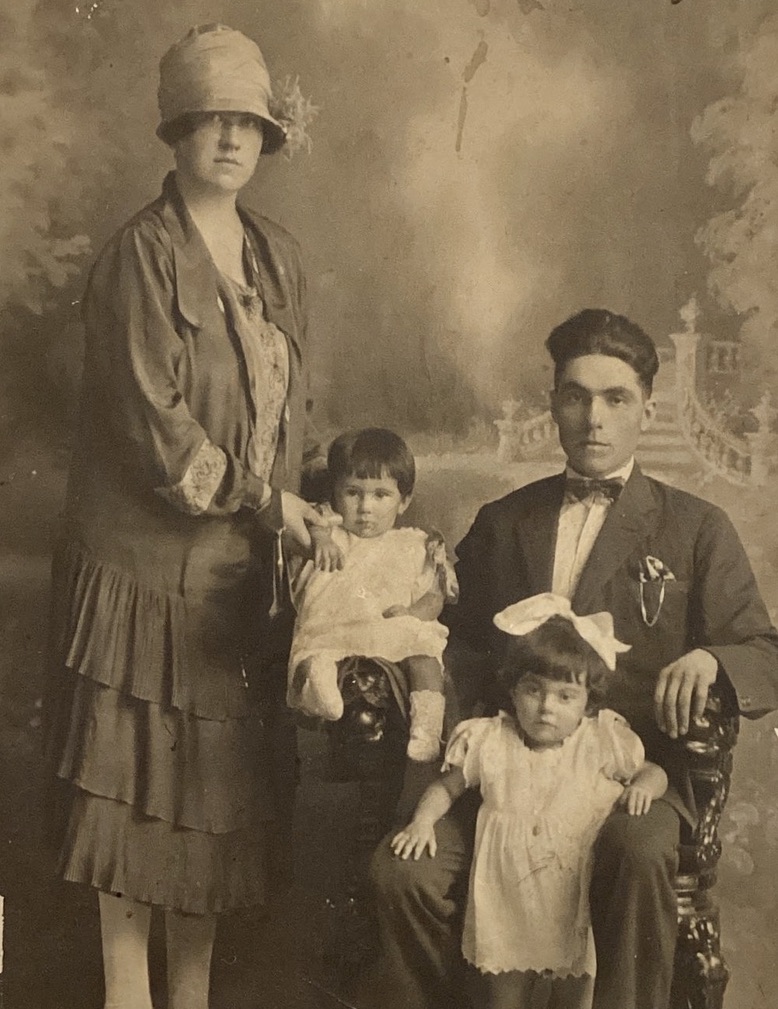
Francesco and Margherita Marchioro with daughters, Mary and Lina, Adelaide, 1927. Connie was born later. Photo supplied by Connie Legovich nee Marchioro.

One of those families was the Marchioro family – Francesco and Margherita and their two young daughters, Mary and Lina, who lived in a boarding house in Hindley Street in the western part of the City of Adelaide. The priest was concerned that some Italian children were not baptised, and the Church was not recognised as a part of family life. However, he did acknowledge that most of the Italians were men and were working in the country areas or in mines and that it would have been difficult for them to attend Church.

At the time, in Port Pirie there were about 200 Italians and in Broken Hill, Fr De Francesco found about 300 Italians.

Italians in Adelaide between the wars

The Italian Catholics in Adelaide usually attended Saint Patrick’s Church in Grote Street in the city. Weddings, baptisms and funerals were conducted from the church which was located in the west of the city where large numbers of Italians were accommodated in boarding houses. Many of the Italian children went to school at St Mary’s Franklin Street adjacent to St Patrick’s. In the part of the city where the Italians lived, a Veneto family, the Rossettos, owned a grocery, and another Veneto family, the Mattiazzos, had a butcher shop.

Domenico Rosettto in the Rossetto grocery, Hindley Street, Adelaide, mid 1930s. Photo provided by Christine Rebellato nee Mattiazzo.
Emilio Mattiazzo, butcher shop, City of Adelaide c 1940s. Photo provided by Maria Rosa Tormena.


The Catholic church in Australia

The way that Italians practised their faith in Australia was different from their experience in their villages in Italy.

Children at a religious event with two priests, Bigolino, mid 1930s. Photo provided by Maria Rosa Tormena.

The parish priest in the village was a very powerful authority and exercised his power in many ways – donating parts of crops to the Church, giving advice about suitable marriage partners and voting in elections. In Adelaide, some Veneto market gardener families attended Sunday Mass while in others, the women and children fulfilled the obligation. However, the full community attended religious rites of passage such as baptisms, first holy communions, confirmations and weddings and enjoyed the celebratory occasions that also marked close connections between families.

The role of the Church

Respect for the authority of the clergy was a fundamental element of the religious, social and cultural framework of the comune in villages in Italy.[1]

Figure 8: Angelina Marchioro, Monte di Malo, c 1937. Photo supplied by Johnny Marchioro.


Angelina Marchioro who left Italy in 1937 remembered the influence of the local priest in Monte di Malo, “Everybody go to church … the priest knew all the families in the little town … they were very strict in the town, the priests,” (Angelina Marchioro nee Marchioro, OH 12/1, 13 March 1984, 5, 7).


The experience of interacting with Catholic priests in Australia was different. In the interwar years, Italians in Australia had to overcome obstacles like language and other cultural differences in the Catholic Church. Irish clergy had dominated Australian parishes and the training of priests since the 19th century. In 1939, the Archdiocese of Adelaide covered extensive suburban areas ,and two thirds of sixty-five diocesan priests were Irish born.[2]

Italians were not fully accepted as a cultural group in the Catholic Church in Adelaide until after the Second World War.[3] In 1946 the Archbishop of Adelaide, Matthew Beovich, the son of a European father, began to address the needs of Italians and appointed an Italian priest to minister to the Italian community in South Australia. Between 1946 and 1949, Father Paul Zolin brought the Catholic Church to the Italian community. He made pastoral visits, offered translating and interpreting services and arranged for a scholarship to support the post-compulsory schooling of boys.

Experience of the Church after World War II

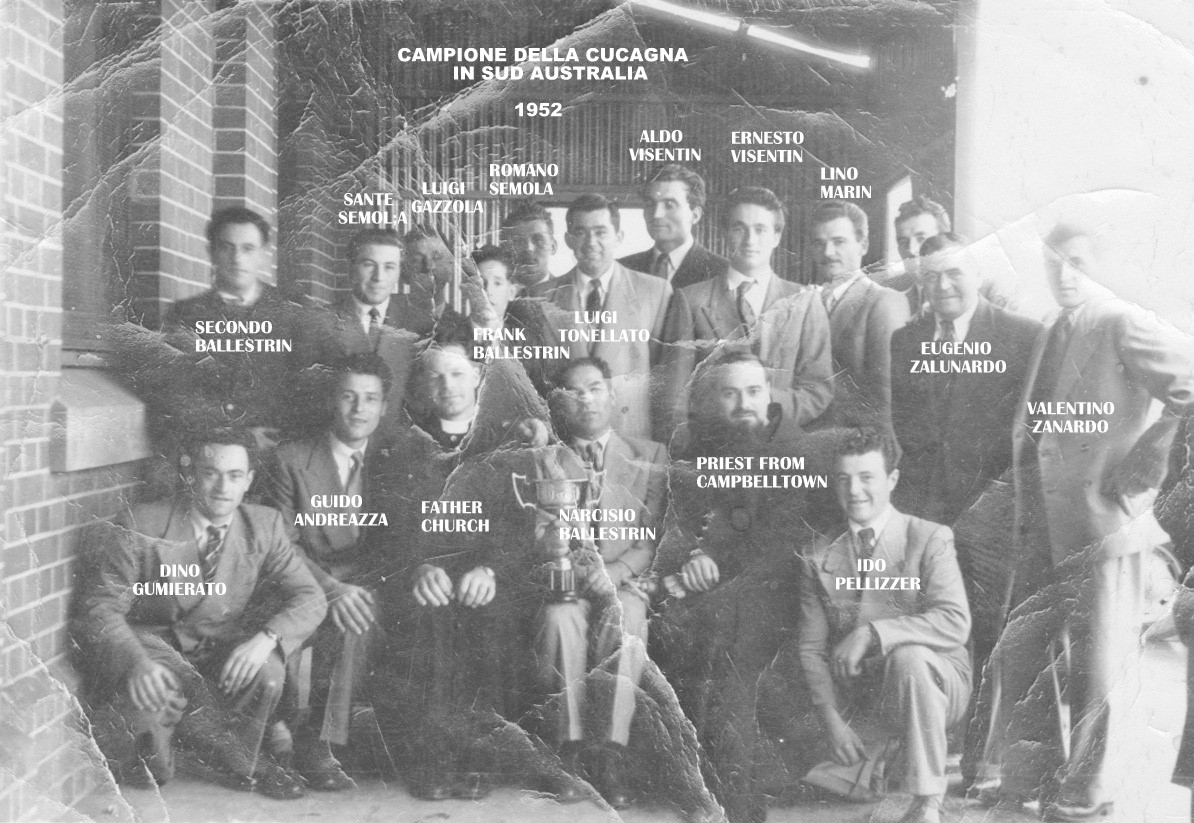
After the Second World War with the increased numbers of Italians, some Sunday Masses were conducted by Italian priests in the Flinders Park church, the closest parish to the Lockleys area. Silvano Ballestrin remembered that the Irish Australian priest supported a distinctive Italian social event, la cuccagna, in the ground of the church in 1952.[4]

La Cuccagna, Saint Joseph’s, Captain Cook Avenue, Flinders Park, 1952.
Photo annotated and supplied by Silvano Ballestrin.

The families adapted a Veneto tradition and organised a procession of decorated horse-drawn carts which led from the market gardeners’ houses to the church grounds accompanied by a boy playing his piano accordion. Teams of men climbed a greasy pole competing for a trophy. Veneto men from a suburb on the eastern side of Adelaide who were accompanied by their Italian parish priest also competed.

Some second-generation narrators remembered that in the late 1950s, when the Italian population was larger, the same parish offered young women and men opportunities to participate in sport and social programs.

A church was built on Grange Road, Seaton in 1954 within walking distance to the market gardeners in the ‘Lockleys’ area, as part of another parish. In 1961, the first Italian priests, the Scalabrini fathers, were invited by the Archbishop “to come to Adelaide to take charge of a proposed new parish of Gleneagles.”  http://www.scalabrini.asn.au/content/parishes

The proximity of the church, which is now in the suburb of Seaton, reflected the location of the church in the heart of villages in the Veneto region.

Madeleine Regan
7 September 2025


[1] Huber, Rina, “From Pasta to Pavlova: A Compariative Study of Italian Settlers in Sydney and Griffith,” (UQ Press, 1977, pp 26-27.)

[2] Josephine Laffin, Matthew Beovich: A Biography. (Wakefield Press, 2008), 105.

[3] O’Connor, No Need to be Afraid: Italian Settlers in South Australia between 1839 and the Second World War, (Wakefield Press, 1996, 131.)

[4] See Silvano Ballestrin, “Parties and Festivals,” Veneto Market Gardeners 1927 Website Blog, 12 July 2020 https://venetimarketgardeners1927.net/?s=Parties+and+Festivals


Bocce and the Veneto community

This blog is based on an earlier one that was posted in February 2021. The feature photo shows a group playing bocce at the Santin market garden in 1962. Photo by Oscar Mattiazzo.

 Bocce or bowls has been a significant game for Italians for hundreds of years. Some historians refer to it dating back to 5000 BC, where evidence of Egyptian cave paintings depict boys playing something that resembles bocce. It is believed that bocce was played in something like its current form in the Roman Empire where Roman soldiers played it between battles against Carthage in the Punic Wars (https://italiantribune.com/italy-and-its-long-history-with-bocce/)

Umberto Granaglia, the world’s greatest bocce player, holds over 70 titles in the sport, a recod that will never be broken. https://italiantribune.com/italy-and-its-long-history-with-bocce/

 Italian migrants in different countries around the world have enjoyed the opportunity to play bocce in backyards, public parks and in Italian Clubs. It has gained popularity in Australia particularly since the post-world War II migrants arrived from Italy. The first national Bocce Championships were held in Australia in 1970. Today it is estimated that over 10,000 people play competitive or recreational bocce in Australia. https://www.bocceaustralia.com.au/about-the-sport/history-of-the-sport/

The expansion of bocce today in Victoria
In an interview with the President of the Bocce Federation of Victoria published today, (24 August, 2025), Laila Favrin, states that “bocce is more than a game – it’s a way to connect communities, celebrate heritage, and build a legacy for the next generation.” Read the short interview here and find out about the wide participation of different age groups who play  bocce and the funding that has been made available for the sport in Victoria using this link:

https://www.bocceaustralia.com.au/news-updates/building-bocces-future-a-conversation-with-laila-favrin-president-of-bocce-victoria/

Veneto market gardeners and bocce
In the oral history interviews for the Veneto market gardeners’ project, some second-generation men recall that their fathers played bocce with friends in the 1930s. They remember that their fathers used to play bocce at the home of a Veneto man who lived at Rosewater. Johnny Marchioro remembered being carried on his father’s pushbike to Rosewater, a trip of about 8 kilometres on Sundays where a group of Veneti played bocce.

Bruno Piovesan, c 1945/46. Photo supplied by Bruno.

Bruno Piovesan recalled that his father played bocce with other Veneto men as an important social event. The love of the game was so important that the men were prepared to continue playing on Sunday during the war years even when movement was restricted and petrol was rationed:

Oh, their social life was pretty limited, I think.  They used to get together of a Sunday afternoon and I suppose they used to just play bowls if they could find a spot.  I remember we used to go down to Rosewater, my father used to go down Rosewater.  But in those years you only had so many gallons of fuel, you were restricted with your fuel because of the wartime and that, and you had to be careful where you drove a truck because if they saw you driving a truck without the purpose of going in the garden industry I think they could have fined you or something.  Yes, that was right.  And used to take a chance and go to Rosewater, they had these bocce courts and that, and as kids we used to go there and just play with all the other kids and their parents at the time, you know, and that was Sunday afternoon fun. 

(Bruno Piovesan OH 872/5, 4 October 2008, 10)

Other Veneto men playing bocce on a court at the back of Elena Stocco’s boarding house in Waymouth Street in the west end of the city of Adelaide. She ran a boarding house for Italians from the 1930s.

Bocce in Adelaide in the 1950s
In the 1950s, Veneto market gardeners and others played bocce at the bocce courts at the back of the Sbrissa family home on River Road, now Findon Road, Kidman Park.  The Sunday competitions were reported in the weekly Catholic paper, The Southern Cross. For example, in an article on 11 June 1954, men were invited to compete in a competition at the home of Signora Clara Sbrissa beginning at 1:00 pm. Prizes were given for the 1st, 2nd and 3rd    place winners. Players registered their interest in participating in the competition by contacting  the President of the Bocce Championships, Eugenio Zalunardo, one of the market gardeners at Lockleys, or with the Italian Vice-Consul.

The enthusiasm for bocce was so great that some people like Amadio Valentini, created a court on his own land at Valetta Road and socialised with local market gardener friends in recreational games.

Amadio Valentini, Giuseppe Mercurio, Valetta Road, late 1950s. Photo provided by Aida Valentini nee Recchi.

Bocce behind the Santin packing shed
The Satin brothers made a bocce court at the back of their packing shed on Frogmore Road at Kidman Park and it was a regular Sunday event that was attended by many men including young ones who had arrived in Adelaide after the war.

Bocce at Santin’s, 1968, Jim Martini, Lido Conci, Oscar Mattiazzo, Frogmore Road, 1968. Photo provided by Christine Rebellato nee Mattiazzo.

Noemi Campagnolo nee Zalunardo remembered that her father used to play bocce at the Santins every Sunday and that the competitions involved only men.

They would been the Santins. Dad used to play bocce there every Sunday and he used to be good friends with all the Santin’s… on Frogmore Road. Well, the women didn’t go, they used to go by themselves so the women did whatever they wanted to do.

Noemi Campagnolo nee Zalunardo OH 872/29, 20 March 2014, p 16

Bocce and the Veneto Club

Veneto Club Women’s Social Committee and group – National Bocce Championships held at the Veneto Club, 1978. Photo supplied by Angelo Piovesan.

When the Veneto Club Inc, Adelaide was established in the early 1970s, bocce competitions and social games were regular events that drew members to the boccedrome at Beverley. Players represented the Veneto Club in competitions in Perth and Brisbane. Annual reciprocal visits were organised with the Veneto Club in Griffith. In 2004, the Veneto Club hosted the 35th Men’s Bocce National Championships.

Women also played bocce and represented the Club at competitions including in  national championships.

Sisters-in-law: Gina Corletto and Serafina De Pieri – bocce team, prize night, Veneto Club, 20 March 1977. Photo provided by Adelina Pavan nee De Pieri.

The interest in bocce has diminished over the past ten or so years in the Veneto community in Adelaide. The South Australian Bocce Federation Inc.  promotes the game as a non-contact sport that can be played by people of any age, gender, and fitness levels.

Madeleine Regan
24 August 2025


error: Content is protected, please contact site owner for access