“We’ve always been together”


 In this blog, you’ll read about the 85-year-old friendship between Assunta Giovannini nee Tonellato and Connie Legovich nee Marchioro, both from Veneto market gardener families in the Lockleys area near the River Torrens in Adelaide.

The image above of Assunta and Connie was taken in Adelaide in  mid 1960s. Assunta supplied the photo.

Assunta’s background

Assunta Giovannini nee Tonellato was born on 20 April 1937 in Broken Hill, the daughter of Assunta Tonellato from Caselle di Altivole in the province of Treviso, and Vittorio Panazzolo from Asolo in the province of Treviso. They married in Adelaide in 1936.

Assunta’s mother had arrived in Adelaide in 1935 accompanying Vittorio’s two young sons. Aged 38 years, she died soon after her daughter was born and her brother and sister-in-law, Secondo and Elisabetta Tonellato, adopted Assunta when she was three months old.

Tonellato family . Back: Lui, Orlando, Rosina, Lino, Albert. Front: Secondo, Assunta, Elisabetta, Adelaide, 1947. Photo supplied by Assunta.

Secondo and Elisabetta were market gardeners in the Lockleys area and had five older children, Luigi, Rosina, Alberto, Lino, and Orlando. The family worked about 25 glasshouses on Frogmore Road and grew mainly tomatoes and beans as well as some outside vegetables.

The Tonellato family in front of the vagòn, Lockleys, 1935. Photo provided by Assunta.

The Tonellato family lived in a train carriage (vagon) built for the 1927 Royal Visit of the Duke (later King George VI) and the Duchess of York.

Assunta recalled that “it was really fitted out beautifully … and we all had our little compartments.”

Connie’s background

Constanza (Connie) Aeda Legovich nee Marchioro was born on 18 April 1938 in Adelaide. She was the youngest of three daughters of Margherita and Francesco Marchioro who had arrived in 1926, the first of the Veneto market gardeners to settle in Adelaide. Connie’s sister, Mary was 13 years older and Lina was 11 years older. Connie reflected in her interview and thought that she might have been a little bit spoilt by her father.

First, Connie’s parents had their market garden on Frogmore Road in the Lockleys area, and then the family moved to the southern side of the River Torrens about 2 kilometres away although they kept close relationships with the other Veneto market gardener families. The Marchioros grew tomatoes in glasshouses and some outside vegetables.

The Marchioro family, Lockleys c 1944. L-R: Lina, Marhgerita, Connie, Mary, Francesco. Photo supplied by Connie.

When she was almost seven years old, Connie’s father died, and her mother continued to work in the market gardens with the help of her older two daughters. Connie has very fond memories of her father and his care of her with little treats. She remembered that her father gave her, her first bike in a big chaff bag for her 6th birthday.

Earliest memories together

Connie remembered the early friendship with Assunta because she loved being in the vagon as it was so different from a conventional home. Her mother was a good friend of Assunta’s auntie, Elisabetta. Her older sister, Lina, was close to Assunta’s sister, Rosina and the families often visited each other on Sundays.

Assunta, First Communion day, c 1944. Photo supplied by Assunta.
Connie, First Communion day, 1945. Photo supplied by Connie.


Connie and Assunta recalled their older sisters carrying them around on their hips (no prams), and they became friends when they were 3 or 4 years of age. Assunta remembered that Rosina always put a ribbon in her hair when she was little. Connie remembers walking to Assunta’s with her doll and pram by herself. Assunta remembers being at Connie’s house and that she used to pop her mum’s fuschia flowers! They both have memories of being donkeyed by their sisters to Henley Beach on a Sunday.

A Sunday at Henley Beach c 1941. L-R: Assunta, Connie, Lina Marchioro, Vito Santin, Joyce Daminato, Albert Tonellato, Rosina Tonellato, Elvio Rebuli, Virginia Santin. Photo provided by Assunta.

 Childhood activities and school

Connie recalled sharing a birthday party with Assunta at the Tonellatos both wearing identical blue smock dresses made by Connie’s sister, Lina when they were 10 and 11 years old.

Loretta Battaglia, Connie, Assunta, Lockleys, c 1945. Photo supplied by Connie.

They played with children from other Veneto market gardener families that lived close by, such as the Piovesans and Ballestrins. Connie and Assunta often dressed up pretending they were film stars and put on performances for Connie’s cousin, Johnny Marchioro, and also Egidio (Jimmy) and Frankie Ballestrin. They played cricket, brandy in the middle, alleys with marbles and rode their bikes on the ‘speedway’ around the vagon.

L-R: Nillo Piovesan, Connie Marchioro, Assunta Tonellato, Dino Piovesan, Jimmy Ballestrin, Frankie Ballestrin, Bruno Piovesan, Frogmore Road, 1945. Photo supplied by the Piovesan family.
In front of the vagòn, Frogmore Road, Lockleys, c 1946-47. L-R: Frankie Ballestrin, Dino and Bruno Piovesan, Connie, Assunta, Nillo Piovesan, c 1948. Photo supplied by Assunta.

Connie went to school at the Convent of Mercy, Henley Beach and treasured her ten years there. She loved sport and has maintained some school friendships over the years, but Assunta has always been her best friend. Assunta attended Flinders Park Primary School and then St Joseph’s Hindmarsh and left after the second year of high school. Because they didn’t go to the same school, they saw each other most weekends. Connie fondly remembered that Assunta baked cakes and especially loved her cream puffs.

 Working lives

Connie helped her sister Lina in her dressmaking business on Prospect Road after school and on Saturdays. After she left school, Connie applied for and won a job at Vogue Overseas Fashions as a hand sewer and worked there for more than 7 years.

When Assunta left school, her mum wanted her to be a dressmaker but she took a different path. She worked in the family glasshouses for 3 months, then worked in a grocery shop in Croydon owned by Oscar Mattiazzo and his wife Virginia Santin. She served in the shop for several years before she went to Italy with her uncle. After returning to Adelaide, Christine Zampin, a daughter in another Veneto market gardener family, got Assunta a job at the Adelaide airport snack bar as a shop assistant and became manager.

Connie, Assunta, Rosanna Tonellato, Adelaide airport, 1972. Photo supplied by Connie.

Later, Connie also worked at the airport as a waitress in the restaurant where Norma Camozzato nee Ballestrin became a cook. Assunta, Connie and Norma used to be the bosses’ favourites. They started work around 5.30 or 6.00am and finished early afternoon and sometimes Assunta and Connie went into town to go shopping, often to buy material for new outfits.

Connie recalled that when they got their long service leave, they went out and bought fur coats! Very fashionable at the time!

Assunta worked at the airport until 1993, retiring at 56 years. Connie had finished in 1980 and nursed in a geriatric hospital for about 7 years. She later went to work with Domiciliary Care for 11 years. Connie had a bad car accident and sometime later, went back to work at Uniting Care 2 days a week for a few years.

Shared social life – as young people

Connie continued to play tennis and netball after she left school. This took up her Saturdays. Assunta didn’t enjoy sport, so she baked or went out on her Lambretta scooter which she bought when she was 19 and sometimes, she would take Connie on the back to the beach.

On Sunday mornings they met up at church in Flinders Park. Assunta, Connie and Tina Martini rode their bikes with their hats on. After church they joined Johnny Marchioro, Bruno Piovesan, and Jimmy and Frankie Ballestrin at the local deli for a coke or an ice-cream. Then they went home for lunch and Connie and Assunta would do their hair and starch their skirts in preparation for the St Patrick’s dance at night. Lina made all Connie’s clothes and she usually wore a new dress every week and Assunta often had new dresses.

Tina Martini, Assunta & Connie, Mary Silvestri, St Patrick’s dance, c 1953. Photo supplied by Assunta.
Assunta and Connie, St Patrick’s dance, early 1950s. Photo provided by Assunta.


Connie and Assunta were dropped off at St Patrick’s by Assunta’s brother Nino and sister-in-law, Rosanna. They remembered they paid 2 shillings for admission They had a fabulous time meeting other young Italians and Connie’s sister always asked, ‘Were you the best dressed there?’ and they would reply, ‘Of course!’


Social life as adults

In 1957 Connie married Tony in St Francis Xavier cathedral and they had two lovely children and 4 grandchildren. There was no question about who would be bridesmaid. Of course, it was Assunta! She was married in the St Francis Xavier Cathedral. Connie was matchmaker for Assunta and Angelo although they all knew one another from St Patrick’s. When Assunta and Angelo were married on 25 May 1968, Connie was Assunta’s matron of honour.

Assunta and Angelo’s wedding, Nano Tonellato and Connie, St Patrick’s church, 25 May 1968. Photo provided by Assunta.

As adult friends they went shopping regularly together. They loved quality clothes and shoes. Connie remarked, ‘We never spared on clothes.’ Assunta said, ‘We’d go out most Saturdays and often on Wednesdays as well.’

They created a tradition of going out to dinner … always fine dining at places in Adelaide. Assunta and Angelo, Connie, Sandra (nee Santin) and Deni Conci enjoyed restaurants like Drumminors, Swains, Ayers House, Cork and Cleaver, Villa Sanzo, Magic Flute, Vittorios, La Cantina and Rigoni’s. Of course, they all got dressed up for these outings.

Assunta and Connie, Bourke, early 1970s. Photo provided by Assunta.


Connie and Assunta rarely went for a weekend without seeing each other. They always spent New Year’s Eve together and went on trips, hunting in Bourke, New South Wales, and also to Sydney.

Connie, Angelo, Assunta, Sydney, early 1970s. Photo provided by Assunta.

Assunta and Angelo enjoyed the company of Connie and Sergio Canonica who reconnected with them all after many years. They spent lots of time together including Sunday afternoons.

Connie, Assunta, Sergio – Assunta’s 80th birthday, Adelaide, April 2017. Photo supplied by Assunta.
Assunta and Angelo, Adelaide, c 2019. Photo supplied by Assunta.


Assunta, Connie, Sergio, Angelo, Adelaide, 2019. Photo supplied by Connie.
Still best of friends after 85 years

Assunta said that these days they don’t have the money to go out fine dining or buying an outfit every week, but they visit friends, go to Burnside Village for window-shopping and lunch. They sometimes go to Veneto Club and Toscana Club events.

When asked what the glue to their friendship has been, they both said they are very compatible because they have known each other for such a long time – and they came from market gardener families whose origins were in the Veneto region. They share a history and the same interests, love talking about clothes, visiting friends together and going to the movies. They are like family as well as friends and they live close to each other in the same area in which they grew up near Frogmore Road.

Having been best friends for 85 years, they have both experienced some tough times and supported each other but mostly they talked about how good life has been. They commented on the many changes that have occurred during that time and mentioned specifically the following changes:

  • in fashion, remarking that the quality of materials was better in the old days
  • food; ‘Everything tasted better once!’ They observed the increase in mass-produced and processed foods
  • in the local area, the density of housing development has grown especially where once open land and market gardens were plentiful.
  • in technology, so many changes, some for good but much that is scary.

Interestingly, both Assunta and Connie consider themselves to be Australian first, with a great respect and love for their Veneto backgrounds and culture.

Assunta and Connie – November 2026. Photo by Madeleine Regan.

What an extraordinary, long-lasting friendship! Congratulations Connie and Assunta!


Madeleine Regan and Mandy Rossetto
8 November 2026

The gift of water


In this blog I use quotes from some people interviewed for the Veneto market gardeners’ oral history project to explore the significance of water. The River Torrens provided a reliable source of water for some, while others whose land was further away, used bores for watering their vegetable crops. Those who lived close to the river grew vegetables like celery that need  abundant water. After the flood mitigation scheme was complete in the late 1930s, flooding reduced, and market gardeners could grow tomatoes and beans in glasshouses and ‘outside’ vegetables like onions, carrots, beetroot, trombones and potatoes. As well as being essential for growing vegetables, the river also became a playground for children of market gardeners

Ballantyne celery market garden, Findon Road, c 1950s. Photo by Rae Ballantyne.


Irrigation from the river
… no restrictions at all in those days.
The only thing it was that there was so many market
gardeners on the river that the water went down and especially in the summer time and you only had holes here and there where your pump was … the river would get that low they used to ring up E&WS [Engineering and Water Supply] in those days and let down two inches of water out of the lake and that would fill up all the holes down the river because it was all full of holes especially on the big bends on the river that washed out the river and there would be a big hole there. … some holes would be about ten feet or more.

Rae Ballantyne OH 87221, 25 August 2012, pp 10-11.

Digging bores
Lino Tonellato arrived as a child in 1935 and remembered that his father and Mr Angelo Piovesan dug a bore on the land at Frogmore Road in the 1930s:

We had, they had put a bore in, they did it themselves, they dug out a hole and put a bore in and they found the water and therefore we were using beautiful water, even better than the tap water it was in them days, until the casing went broke, it was rusty, and then it was a bit salty, but before that it was beautiful water. We used to drink that water instead of the tap water.

Lino Tonellato OH 872/10 16 July 2010, pp 5-6.

The depth of bores
Mel Recchi, whose parents had a market garden on Findon Road, explained the ways that market gardeners depended on different sources of water:

Giovanni Recchi, Findon Road, 1966. Photo courtesy of the Recchi family.

Most of them had bore water … I think the water table is only down about 15 or 20 feet … But you might put a pump down, might go down to 40, 50 feet, maybe 60 feet, at the most. [Our] bore was here when we came. And the pump was virtually, approximately 20 feet underground so we dug down, well when they put it down, they would have dug down and shored it up with timber and the pump was about 20 feet below ground level with a pipe going in another 25, 30 feet to get to the water, to get to the water basin.

Mel Recchi OH 872/31, 18 June 2014, p 16.


Salt in the water
Anna Santin nee Mattiazzo, who worked with her sisters-in-law on the Santin brothers market garden on Frogmore Road, raised an interesting point about the quality of the bore water:

Vito and Anna Santin nee Mattiazzo, Frogmore Road, c 1960s. Photo courtesy Anna Santin.


… you used to have to keep an eye on it then. If it got too salty you couldn’t use it and so, we had to bore another one after a few years, a new one, and they used to have to keep an eye on it. Otherwise, it would be too salty and burn all the plants.

Anna Santin nee Mattiazzo  OH 872/24 3 April 2013, p 26.


The bore as protection from the heat
Johnny Marchioro explained the necessity for market gardeners, like his parents, to have a bore and remembered that they used the bore for another purpose in the Adelaide summer heat:

Angelina & Vittorio Marchioro & Romano & Johnny, Frogmore Road, c 1943. Photo courtesy Marchioro family.

They had to have a bore because your tap, mains water – would have been dear at the time, too – but you wouldn’t have got enough water to water these acres of your glasshouses and outside vegetables … when it was real hot they used to go and cool down in this well. The well was about a four-foot hole, about twenty foot deep and it was padded up with timber that went down there, …  I don’t know how they got that done back in the ’30s.

Johnny Marchioro OH 872/1, 21 July 2008, p 23.


The river as play space

Marchioro family: Angelina, Vittorio, Romano, Johnny, Frogmore Road c 1947. Photo, Lina Marchioro.

Romano Marchioro remembered the River Torrens as a place of play and adventure:

I spent half of my younger years in the river, River Torrens. And some of the bigger boys used to come there and we used to go fishing. and we used to … In those days it used to run dry in a lot of places and there’d be big pools of water and we’d all get there with buckets and throw all the water out and all the fish would be down in the bottom and all the yabbies would crawl out the sides of the banks. And we’d end up with heaps of yabbies and fish … There used to be perch. And congollis, long skinny fish. They were edible fish … I used to go always go yabbying and bring them home … we used to have fun.

Romano Marchioro, OH 872/20, 11 June 2012, p 8.


The full transcripts of the interviews can be found on the respective family pages of the website.

Madeleine Regan
20 March 2020


Once upon a time …

In this blog, I continue to look at the early days of the market gardeners who lived and worked in what they called the Lockleys area, north of the River Torrens. In the last blog, I wrote about James Ballantyne who had been allocated a soldier settler block on the River Torrens in 1923 which he and his family worked until the late 1970s.

This time the focus is the first Veneto market gardeners who began establishing their gardens from the early 1930s. In 1986 a journalist wrote an article about ‘Italian pioneers in Adelaide’ for the Italian Australian religious magazine, Il Messaggero or “The Messenger.” Thanks to Assunta Giovannini nee Tonellato who first showed me the article ten years ago, we have an account of the early days of Secondo Tonellato. He was one of the first Veneto market gardeners to lease land and called his wife Elisabetta and children, Luigi, Rosina, Albert, Lino and Orlando to join him in 1935. In 1937, Secondo brought his three-month old niece, Assunta, into the family.

Tonellato family, Adelaide, c1945/1946: Back- Luigi, Orlando, Rosina, Lino, Albert.
Front: Secondo, Assunta, Elisabetta. Photo provided by Assunta Giovannini nee Tonellato.

The journalist, whose name is not provided, had evidently talked with the family of Secondo and Elisabetta to document the story of Secondo Tonellato from 1927 and the vision he had to accommodate his wife and children. The Tonellato parents had died in the early 1970s. The journalist gives an overview of the first decades at Kidman Park and the changes that have occurred in the area: the land and the river, work of market gardeners, the loss of the market gardens and the transformation in the population. In 1986 when the journalist published the article there were still some glasshouses and market gardeners in the area. Thank you to Graziella Ledda for assisting with the English translation.

—————————————————————–

Once upon a time there was a family who lived in a railway carriage …
Once upon a time … it always begins like that, doesn’t it? There was once a large expanse of grasslands, fields and sandhills, bushes that went almost down to the sea, a lazy river, the Torrens, which lost its way in a salty marsh, full of mosquitoes. It was in a south-west suburb, a few kilometres from the famous green belt of the city of Adelaide.

The first migrants whose names people still remember were Piovesan, Berno, Tonellato, Ballestrin, Laio etc. Unlike the Australian rural regions with cattle and sheep farms, this land was dedicated to horticulture. There were a series of glasshouse of which you can still see some examples today. One pioneer, to take an example, began their life in the following way …

Secondo Tonellato came to Adelaide in 1927 from the Province of Treviso. He worked for a boss and when he felt he could stand on his own feet in 1935, he bought a train carriage which had accommodated King George VI when he visited Australia [The Duke of York who later became George VI had visited Adelaide with his wife in 1927].

onellato family, Lockleys 1935. L-R: Nano, Elisabetta, Albert, Lui, Rosina, Secondo, Lino.
Tonellato family, Lockleys 1935.
L-R: Nano, Elisabetta, Albert, Lui, Rosina, Secondo, Lino.

Our Secondo had to provide decent accommodation for his family who came to join him. He paid for transporting the carriage which was placed at the end of the existing Fergusson Avenue, Kidman Park. The carriage was beautiful, as his sons recall today.

Inside it was upholstered with leather and there were etched scenes on the glass windows. The compartments were used as bedrooms and a dining room. There was even a shower! The family cooked outside in a shed.

River Torrens, 1937. Ballantyne family house and market garden in left background. Photo provided by Rae Ballantyne.

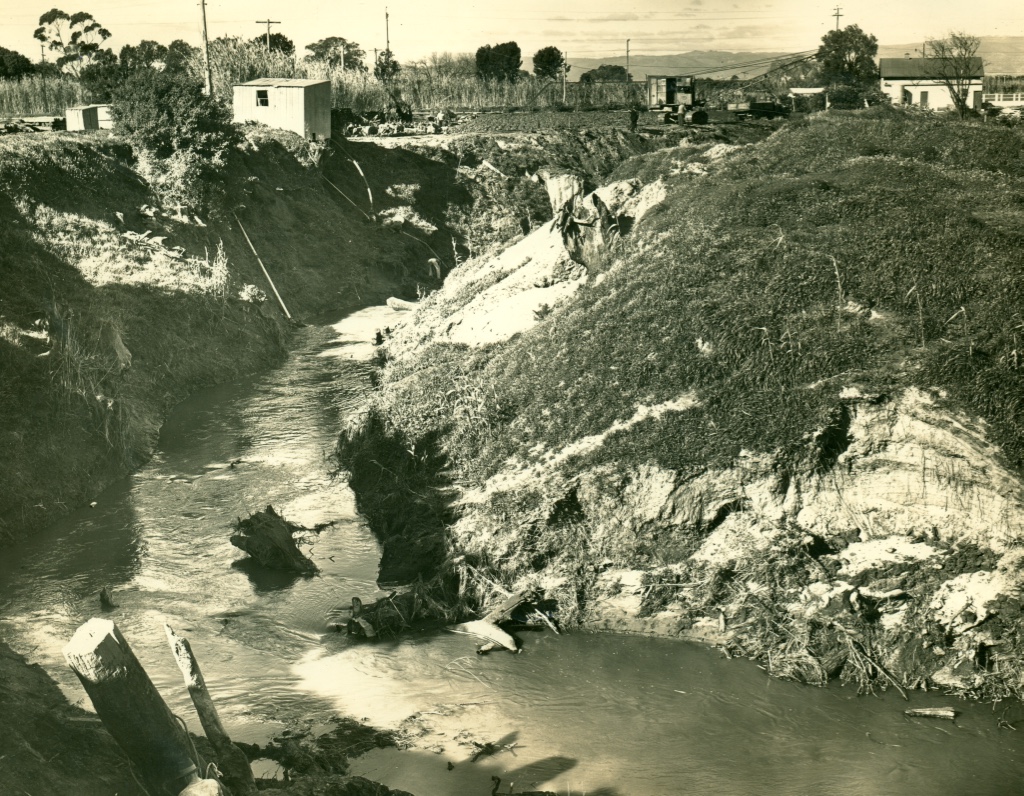
In those years, the land was not as it is today. The unpredictable River Torrens, which in dry times, was like a creek painted on canvas, played up when it freely flooded the land destroying the harvest of the farms there. In 1937-1938 an enormous embankment was built in the Kidman Park while the land near the mouth of the river remained marshy, bushy and full of snakes for some years.

As the years passed, Tonellato built a new home for his family. From 1954 and for some years, the famous carriage served as lodgings, a place of safety and welcome for many new migrants who, in increasing numbers, looked for stable accommodation in the area. It was a great shame that it was not preserved as a precious memorial or monument. In the end it was completely destroyed by fire.

—————————————————————–

The Tonellato vagòn was a significant landmark – and story -for the Veneto market gardener community. Many people have referred to it in their oral history interviews. In 1997, another journalist, Ennio Tessari, wrote an article about the Tonellato vagòn in a report on the Fourth Convention of the Trevisani d’Australia which was held in Adelaide in October that year.

The Tonellato vagòn was also the subject of two blogs by Alex Bennett in April 2021. See: Part 1: https://venetimarketgardeners1927.net/page/2/?s=Alex+Bennett

Part 2: https://venetimarketgardeners1927.net/?s=Alex+Bennett

Madeleine Regan
6 March 2022

error: Content is protected, please contact site owner for access